


Campo (Vallemaggia)
| Campo (Vallemaggia) | |
|---|---|
-coat_of_arms.svg) | |
| Basisdate | |
| Staat: | Schwiiz |
| Kanton: | Tessin (TI) |
| Bezirk: | Vallemaggia |
| Kreis: | Rovana |
| BFS-Nr.: | 5307 |
| Poschtleitzahl: | 6684 |
| Koordinate: | 680515 / 126303 |
| Höchi: | 1'321 m ü. M. |
| Flächi: | 43.15 km² |
| Iiwohner: | 49 (31. Dezämber 2022)[1] |
| Website: | www.campo.ch |
 Campo | |
| Charte | |
_2008.png) | |
Campo (Vallemaggia) (lombardisch Camp oder Chièmp, im Walserdialäkt vu Bosco/Gurin Ggååm  [kɔːm](info)) isch e Gmai im Kanton Tessin in dr Schwyz. Si ghert zum Chrais (circolo) Rovana im Bezirk Vallemaggia.
Geografi[ändere | Quälltäxt bearbeite]
Campo lyt im obere Valle di Campo un bstoht us dr Ortsdail Cimalmotto (1405 m), Campo (Mezzo), Piano un Niva (955 m).
Gschicht[ändere | Quälltäxt bearbeite]
Im 15. Jh. het s Valle di Campo mit Cevio, Bignasco un Cavergno d Roana Superior bildet. Bis 1513 het Campo zue dr Bfarrei Cevio ghert.
Verwaltig[ändere | Quälltäxt bearbeite]
Dr Gmaisbresidänt (Sindaco) vu Campo isch dr Piergiorgio Campagnoli.
Bevelkerigsentwicklig[ändere | Quälltäxt bearbeite]
Quälle: Bundesamt für Statistik 2005[2]
| Johr | 1850 | 1860 | 1870 | 1880 | 1888 | 1900 | 1910 | 1920 |
| Yywohner | 506 | 429 | 429 | 397 | 358 | 291 | 269 | 256 |
| Johr | 1930 | 1941 | 1950 | 1960 | 1970 | 1980 | 1990 | 2000 |
| Yywohner | 201 | 187 | 182 | 143 | 95 | 59 | 47 | 58 |
Dialekt[ändere | Quälltäxt bearbeite]
Dr lombardisch Dialäkt vu Campo ghert zum Ticinese.
Böuwärch[ändere | Quälltäxt bearbeite]
- Chilche S. Bernardo, Campo (14. Jh., in dr erschte Helfti vum 16. Jh., um 1620 un 1740-45 vergreßeret), mit Freske vum Giuseppe Mattia Borgnis (vu 1745)
- Chilche S. Rocco, Niva (1630)
- Chilche Beata Vergine Assunta, Cimalmotto
- Kapäll San Luigi Gonzaga
- Oratorio di Santa Maria Addolorata (1767/68)
- Oratorio di San Giovanni Battista (1749)
- Oratorio di San Carlo Borromeo, Piano (16. Jh.)
- Oratorio di Sant'Antonio da Padova, Seccada (1750)
- Chryzwäg
- Palazzo Pedrazzini «ad Fontem» (18. Jh.)
-

Chilche S. Bernardo -
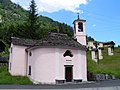
Oratorio di Santa Maria Addolorata e Via Crucis -

Oratorio di San Giovanni Battista -

Palazzo Pedrazzini «ad Fontem» -

Chryzwäg


Literatur[ändere | Quälltäxt bearbeite]
- Celestino Trezzini: Campo Vallemaggia. In: Historisch-Biographisches Lexikon der Schweiz, Band 2: Brusino – Caux. Attinger, Neuenburg 1921, S. 482-483.
- Otto Lehmann: Die Gestaltung der Landschaft im Bereiche der grossen Massenanhäufungen in der Gemeinde Campo (Valle Maggia). In: Mitteilungen der Geographisch-Ethnographischen Gesellschaft. Band 34, Zürich 1933–1934, S. 25–74 + 6 Tafeln (Digitalisat)
- Guglielmo Buetti: Note Storiche Religiose delle Chiese e Parrocchie della Pieve di Locarno, (1902), e della Verzasca, Gambarogno, Valle Maggia e Ascona (1906). 2. Auflage, Pedrazzini Edizioni, Locarno 1969.
- Giovanni Bianconi: Vallemaggia. Edizioni L.E.M.A., Agno 1969, S. 33–36, 46.
- Martino Signorelli: Storia della Valmaggia. Tipografia Stazione SA, Locarno 1972, S. 92, 121, 149, 151, 173, 174, 196, 221, 225, 228, 282, 325, 327, 342, 344, 348, 362, 397, 420.
- Agostino Robertini, Silvano Toppi, Gian Piero Pedrazzi: Campo Vallemaggia. In: Il Comune. Edizioni Giornale del Popolo, Lugano 1974, S. 75-90.
- Giuseppe Mondada: Commerci e commercianti di Campo Valmaggia nel Settecento. Edizioni del Cantonetto, Pedrazzini Tipografia-Offset, Locarno 1977.
- Simona Martinoli und andere: Guida d’arte della Svizzera italiana. Edizioni Casagrande, Bellinzona 2007, S. 237, 252, 253, 255, 256, 257.
- Franco Binda: Il mistero delle incisioni. Armando Dadò editore, Locarno 2013, ISBN 978-88-8281-353-6.
Weblink[ändere | Quälltäxt bearbeite]
 Commons: Campo, Vallemaggia – Sammlig vo Multimediadateie
- http://www.campo.ch
- Daniela Pauli Falconi: Campo. In: Historisches Lexikon vo dr Schwiiz.
Fueßnote[ändere | Quälltäxt bearbeite]
- ↑ Ständige Wohnbevölkerung nach Staatsangehörigkeitskategorie, Geschlecht und Gemeinde, definitive Jahresergebnisse, 2022. Bei späteren Gemeindefusionen Einwohnerzahlen aufgrund Stand 2022 zusammengefasst. Abruf am 7. September 2023
- ↑ Bundesamt für Statistik: Eidgenössische Volkszählung 2000: Bevölkerungsentwicklung der Gemeinden 1850–2000. Bern 2005 (Online uf bfs.admin.ch (Site cha nüme abgrüeft wärde; Suche im Webarchiv) , Date im Aahang (Site cha nüme abgrüeft wärde; Suche im Webarchiv) )
